

Applications of Piezoelectric Ceramics
A piezoelectric system can be constructed for virtually any application for which any other type of electromechanical transducer can be used. For any particular application, however, limiting factors include the size, weight, and cost of the piezoelectric system. Piezoceramic ceramic devices fit into four general categories: piezo generators, sensors, piezo actuators, and transducers. Characteristics of each piezoelectric material are briefly summarized here.
Piezoelectric Generators
Generally, there are two types of piezoelectric generators:
- Single-layer generators: Piezoelectric ceramics can generate voltages sufficient to spark across an electrode gap, and thus can be used as ignitors in fuel lighters, gas stoves, welding equipment, and other such apparatuses. In these piezoelectric applications, the ignition button attaches to a spring-loaded hammer. The force of the hammer exerts itself on a single-layer, rod-shaped piezoelectric ceramic, thus producing voltage and causing the necessary spark gap that ignites the fuel source. The resulting electrical energy of a single-layer generator generates a high voltage at a low current over an incredibly quick timeframe. Piezoelectric ignition systems are small and straightforward — distinct advantages relative to alternative methods that include permanent magnets or high voltage transformers and capacitors. They also last longer and require little maintenance.
- Multilayer generators: Alternatively, the electrical energy generated by a piezoelectric element can be stored. By utilizing a different configuration of piezoelectric ceramics, techniques used to make multilayer capacitors have been used to construct multilayer piezoelectric generators. Due to producing a significantly higher current with no electromagnetic interference, such piezo generators are excellent solid state batteries for electronic circuits. With advancements in technology, micro-electric systems have allowed manufacturers to decrease the size of many popular electronics. Seeing as how smaller products require less power, multilayer generators that receive power from piezoelectric ceramics have become realistic power sources compared to other sources. Current piezo applications of multilayer generators can be found in wireless sensors, munitions and tire pressure sensors in vehicles.
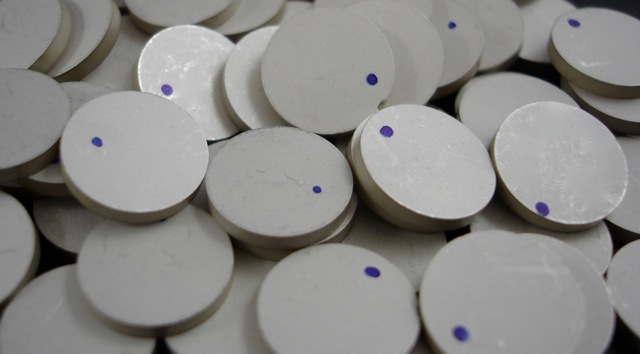
Learn more about piezoelectric generators here!
Piezoelectric Sensors
A piezoelectric sensor converts a physical parameter, such as acceleration or pressure, into an electrical signal. In some sensors the physical parameter acts directly on the piezoelectric element; in other devices an acoustical signal establishes vibrations in the element and the vibrations are, in turn, converted into an electrical signal. Often, the system provides a visual, audible, or physical response to the input from the piezoelectric sensor -- automobile seatbelts lock in response to a rapid deceleration, for example.
There are predominately two kinds of sensors used in piezoelectric sensor applications:
-
Active: Active sensory means piezoelectric ceramics measure the flight of a pulse-echo response between a transmitter and receiver. You can use piezoelectric ceramics to fulfill both roles, as transmitters usually operate at their resonance frequency while receivers will work in anti-resonant mode. Examples of active sensory equipment include flow sensors and meters, thickness gauges, and diagnostic ultrasounds.
- Passive: In this regard, piezoelectric ceramics operate below their resonance frequency to produce a broader band response. These circumstances allow the ceramic to receive a signal across a wide frequency range. Passive sensing applications include microphones, accelerometers, musical pick-ups and more.
Due to the high elasticity of piezoelectric ceramics and other applicable materials, they can adapt to various shapings without losing the key traits that make them useful. They don't show much deflection in the face of compression, which gives them ruggedness, as well as a high natural frequency. They're also resistant to electromagnetism and radiation, allowing them to provide accurate readings in various environments.
With sensor applications in mind, you'll often find soft piezoelectric materials in various piezo sensors in medical, nuclear and aerospace instrumentation, as well as in the touch pads of smartphones and tablets. In addition, soft piezo materials polarize easily, have large charge coefficients, permit electrical energy storage and have high coupling factors.
Piezo Actuators: Multilayer, Stack, Bending, Stripe
A piezo actuator converts an electrical signal into a precisely controlled physical displacement, to finely adjust precision machining tools, lenses, or mirrors. Due to their small size, simple design, high reliability and independence of lubrication, you'll see various actuators implemented throughout a vast range of industries, including automotive, aviation, medical, consumer electronics and aerospace. In fact, a piezo actuator can activate more than one billion times without even deteriorating.Actuators also are used to control hydraulic valves, act as small-volume pumps or special-purpose motors, and in other applications.
You'll also find them in many loudspeakers, as the generated voltage converts electric into the mechanical movement of a metallic diaphragm. They're also a vital component of atomic force microscopes and scanning tunneling microscopes, which employ converse piezoelectricity to keep the tool's sensing needles close to the specimen.
Piezoelectric motors are unaffected by energy efficiency losses that limit the miniaturization of electromagnetic motors, and have been constructed to sizes of less than 1 cm3. A potentially important additional advantage to piezoelectric motors is the absence of electromagnetic noise.
There are two different types of piezo actuators / multilayers. The first is a stack actuator. A stack actuator is constructed in one of two ways: discrete stacking or co-firing depending on the user’s requirements.
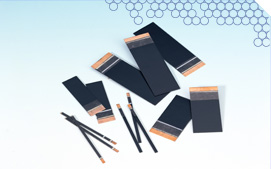 The other type of piezo actuator is a stripe actuator or bending actuator, in which thin layers of piezoelectric ceramics are bonded together; the thin layers allow the actuator to bend with a greater deflection but a lower blocking force than a stack actuator.
Alternatively, if physical displacement is prevented, a piezo actuator will develop a usable force. Additionally, piezo actuators, when acting in an energized state, consume almost no power and produce minuscule amounts of heat, which makes them supremely efficient.
Learn more about piezo actuators here!
Piezoelectric Transducer
Piezoelectric transducers convert electrical energy into vibrational mechanical energy, often sound or ultrasound, that is used to perform a task.
Transducers that generate audible sounds afford significant advantages, relative to alternative electromagnetic devices -- they are compact, simple, and highly reliable, and minimal energy can produce a high level of sound. These
Because the piezoelectric effect is reversible, a transducer can both generate an ultrasound signal from electrical energy and convert incoming sound into an electrical signal. Some devices designed for measuring distances, flow rates, or fluid levels incorporate a single transducer in the signal sending and receiving roles, other designs incorporate two transducers and separate these roles.Their characteristics are ideally matched to the needs of battery-powered equipment.
Piezoelectric transducers also are used to generate ultrasonic vibrations for cleaning, atomizing liquids, drilling or milling ceramics or other difficult materials, welding plastics, medical diagnostics, or for other purposes.
APC International, Ltd. — Supporting the Cutting Edge of Piezoelectric Applications
At APC International, our philosophy has always been to listen closely to the needs of each of our customers so that we understand exactly what they want. Then, with our highly trained staff and state-of-the-art manufacturing facility, we’re able to meet those needs with either standard or customized piezoelectric ceramics and devices.
Our continuous development of piezo materials has assisted in their numerous and growing applications. Consider the following uses in a range of industries:
- Consumer goods: Jewelry cleaners, cigarette lighters, musical instrument pickups, smartphone speakers, musical greeting cards
- Medical devices: Ultrasonic equipment, disposable monitors, fetal heart monitors
- Automotive components: Seat belt sensors, keyless door pads, tire pressure sensors
- Computer equipment: Inkjet printers, disk drives
- Defense applications: Guidance systems, depth sounders, sonar equipment
In addition, our dedication to supplying you with the service you require at each step of the manufacturing process — from the initial design phase through final product testing — means you'll always get the right piezo product for your needs.
Ready to learn more about how we can be your one-stop shop for all of your piezo material needs? Contact us or give us a call at (570) 726-6961 today, and find out why APC International is an industry leader in engineering and designing the latest in piezo products and applications.
Explore Our Additional Resources On Ceramics:
Piezo Ultrasonic Sensor Applications
|
|
For much more information about piezoelectric ceramics and their uses, order our book |