


Piezo Air Transducers
Transmitter, receiver, or transmitter / receiver units (environmental housing)
25 kHz, 40 kHz, and 300 kHz signal frequency
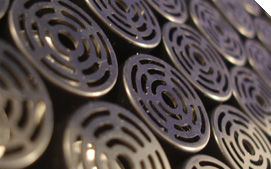
- high sensitivity
- excellent sound pressure
- low cost
- 10 mm to 25 mm diameter
- matched pairs available
- custom specifications welcomed
- competitive pricing
- fast delivery
Typical Applications of Piezoelectric Transducers
- automobile sensors
- proximity sensors
- object detectors
- level sensors
- remote controls
- motion detectors / intruder alarms
- pest deterrents
- toys / games
Our air transducer applications consist of a piezoelectric ceramic element, mounted in an aluminum, plastic, or environmental (sealed) housing. These piezoelectric transducers offer high sensitivity, superb sound pressure level (SPL), and stable electrical and mechanical characteristics, at a choice of bandwidths and vary in frequencies and amplitudes. Environmental transducers may act as both transmitter and receiver; or separate transmitter or receiver.
Background information about ultrasonic air transducers
Custom Design and Engineering Services of Piezoelectric Ultrasonic Air Transducers
We can custom design air transducers for unique requirements and electrical properties. If the design you need is not listed here, please contact an APCI representative to discuss your specifications
Ultrasonic Air Transducer Module
APC offers an ultrasonic air transducer module (Cat# 10-3300) for use in conjunction with our standard 300 kHz air transducer (Cat# 10-3310). APC's air transducer module can be used for short distance measurement, close object detection, and level sensing. View the product spec sheet for more details.
Standard Ultrasonic Air Transducers & Modules
Models listed below are RoHS compliant
Other units are available on request - please inquire.
For data with respect to a specific unit, click on the PDF link.
| APCI Catalog No. |
Center / Resonance Frequency (kHz) |
Transmitter / Receiver |
Output SPL (at 10V) (dB) |
Sensitivity (dB) |
Bandwidth (-6 dB) (kHz) |
Outer Diameter (mm) |
Housing | |
| 10-3210 | 40 kHz Sonar Ranging Module (50-1500 cm) | Spec Sheet | ||||||
| 10-3240 | 40 kHz Sonar Ranging Module (25-150 cm) | Spec Sheet | ||||||
| 10-3300 | 300 kHz Air Transducer Module with Driver Board & Transducer | Spec Sheet | ||||||
| 10-1011 | 25 ±1 | T | >112 | -- | 4.0 | 16.0 | Aluminum | Spec Sheet |
| 10-1016 | 25 ±1 | R | -- | ≥-65 | 3.5 | 16.0 | Aluminum | Spec Sheet |
| 10-1036 | 40 ±1 | T | >112 | -- | 4.0 | 10.0 | Aluminum | Spec Sheet |
| 10-1041 | 40 ±1 | R | -- | ≥-69 | 2.0 | 10.0 | Aluminum | Spec Sheet |
| 10-1061 | 40 ±1 | T | >115 | -- | 4.0 | 12.7 | Aluminum | Spec Sheet |
| 10-1066 | 40 ±1 | R | -- | ≥-67 | 2.0 | 12.7 | Aluminum | Spec Sheet |
| 10-1096 | 40 ±1 | T | >119 | -- | 4.0 | 16.0 | Aluminum | Spec Sheet |
| 10-1101 | 40 ±1 | R | -- | ≥-65 | 3.5 | 16.0 | Aluminum | Spec Sheet |
| 10-1106 | 40 ±1 | T | >119 | -- | 4.0 | 16.1 | Plastic | Spec Sheet |
| 10-3066 | 40 ±1 | R | -- | ≥-70 | 3.0 | 9.7 | Plastic | Spec Sheet |
| 10-3111 | 40 ±1 | T | >112 | -- | 2.5 | 9.7 | Plastic | Spec Sheet |
| 10-3041 | 40 ±1 | T/R | >103 | >78 | 1.0 | 14.0 | Plastic | Spec Sheet |
| 10-3005 | 40 ±1 | T/R | >110 | ≥-68 | 2.0 | 9.7 | Aluminum | Spec Sheet |
| 10-3133 | 40 ±1 | T/R | >102 | ≥78 | 3.0 | 8.0 | Stainless | Spec Sheet |
| 10-3155 | 40 ±1 | T/R | >115 | ≥-68 | 2.0 | 12.7 | Aluminum | Spec Sheet |
| 10-3165 | 40 ±1 | T/R | >117 | ≥-65 | 2.0 | 16.2 | Aluminum | Spec Sheet |
| 10-3170 | 40 ±1 | T/R | >117 | ≥-65 | 2.0 | 16.2 | Plastic | Spec Sheet |
| 10-3136 | 40 ±1 | T/R | >108 | ≥-75 | 2.0 | 18.1 | Environmental | Spec Sheet |
| 10-3235 | 40 ±1 | T/R | >113 | ≥-72 | 2.0 | 25.1 | Environmental | Spec Sheet |
| 10-3310 | 300 | See Spec Sheet | 9.8 | Plastic | Spec Sheet | |||
| Custom | Values to be Determined by Customer and APC International | |||||||